As I mentioned in the last post, SpaceInvaderOne is a brilliant resource for UnRAID – and a bunch of other things besides. It also doesn’t hurt that he’s a Brit based out of one of my favorite cities in the UK, Bristol.
I’ve mentioned a bit about parity in these posts and, if you’re wondering how it works, he has a brilliant explainer here.
He also talks in a subsequent video about key plugins to use with UnRAID. I was expecting a list of plugins, which is what I got, but also something even more impressive and much better than the disparate group of different plugins with different install techniques and documentation that I was expecting …
Community Applications
Community Applications is the plugin you must install with UnRAID, because it makes everything else so damn easy. I’m not kidding – once it’s installed, this is your one-stop-shop for searching for plugins and one-click installing them. Most plugins I’ve found will also link you directly to the UnRAID Community Forum thread for that plugin should you have questions or just want to find out more.
It’s easy and brilliant and exactly what it should be. SpaceInvaderOne had some particular recommendations which I followed because after all, he’s the expert.
Plugins
The first one to install is Fix Common Problems, which does exactly what it says on the tin. It scans your system, and tells you if things are configured incorrectly, not configured at all and should be, or anything else that means your system could potentially not be running at its best.
Next up is the Dynamix series of plugins. These do everything from allowing you to schedule a cronjob to do regular SSD TRIM operations on any SSDs you have installed on the system that support them, to helpful visualization tools to show easy disk usage and system temperature information. There are a bunch more that I need to explore, but they really seem to have thought of a ton of use cases and developed for them.
It’s Getting Hot in Here
One of the things I really wanted for this machine was for it to be quiet. No shit right? Half the components I ordered are literally from a company with that name. My biggest concern was balancing temperature and noise – it’s relatively easy to keep a machine cool if you blast air through it at high speed, but that comes with a lot of noise. Equally it’s easy to keep a machine quiet – lots of large fans run at slow speed – but that tends to let things get hot.
It probably didn’t help that we had an unseasonably warm week this week, and that I was adding a third machine to a room that already had two in it, but I’ve been seeing temperatures that are a little higher than I would really like, thanks to the Dynamix System Temperature plugin.
My existing machine runs at mid-30s at idle, and I stress tested it up to 85 degrees which is well within tolerances for the hardware – but that’s in a larger case with better ventilation at the front, and fewer cores.
I cranked my fan controller on the case from ‘Silent’ to ‘Performance’ but it honestly didn’t make much difference – however the BIOS is also set to Silent, so I may need to reboot and play around with those settings to crank the fans up a bit without making it too loud.
There’s also a reasonable chance that I screwed up the heatsink somehow, with the mounting issues I mentioned earlier. Either way, once I have the machine fully up and running and I’m ready to move the rest of the disks over, I need to do a lot of cable management to get the machine into its final state, so I can remount the heatsink if I need to, and move some fans about.
So Plexy
The main barrier to swapping machines is replacing the Plex server running on Windows with the new Blackjack hosted data. As mentioned in my first UnRAID post, I had intended to run Plex on Ubuntu, but I changed my mind and went for a straight-up container. This meant that installing Plex was simpler than its ever been. I setup a couple of shares for the media, pointed Plex at them, and it was ready to roll.
Obviously there’s nothing in it yet, I still need to migrate all the media over (a process ongoing as I write). The last thing then is to try and migrate the database, keeping all of the ‘watched/unwatched’ tallies for me and the other users. Once that’s done and confirmed, I can delete the data from the Windows machine and relocate the disks.
No-IP
Remote access to this box is going to be important. I’ve used No-IP for years for keeping my domain name linked to the IP of wherever my machines are located. Usually this was an app installed on my machine but now I’m in the world of containers my first question is ‘Is there a container for that?’
The answer is yes, so I’ve now offloaded one more thing to the main system that I don’t have to worry about a guest OS doing.
A couple of things I forgot to mention in the last post.
Firstly on the built-in fans; the two fans were identical, but held in with very different screws. The rear fan had what I would consider to be ‘regular PC case screws’, but the front fan was held in with odd small stubby screws which, when removed, had a strange sticky gasket attached to them which sort of broke away as I removed them.
Perhaps typical purchasers of these cases don’t remove the existing case fans and just add to them but … I found it an odd difference, and a disappointing lack of quality on the front screws.
Lastly, the ‘cable management’ around the back of the motherboard tray started out well, but started to become problematic. The case panel is lined with a foam insert, which is great for deadening vibrations and thus noise, but it means there’s not a lot of space in there. My goal was to keep the motherboard side of the case clean and clear, but I may need to let more cabling into the body of the case in order to not have everything so smooshed up behind it.
Anyway, it was another day before I could get the machine connected up to a monitor and to begin working on it. I booted into the BIOS/UEFI setup first to tweak things and see what I was dealing with.
The ASRock Z460 Taichi has what I’d call a ‘typical’ UEFI setup screen – graphics that (to me) hark back to 90s Japan, but it was functional and let me get to what I need. I went through all the settings, making sure to enable the virtualization features, as well as turning on the IOMMU passthrough features I’d need later.
I probably spent most time fiddling with the motherboards’ built-in LEDs. They do all sorts of things, but I just wanted a static white light. I’ve yet to see if I’ll be able to install software on my Windows VM to manage that further – possibly turning it off at night automatically – but for now it’s fine.
That’s right, the God Box has a name. My previous naming conventions followed The Expanse series of books (and now TV), but here I’ve swapped one form of plagiarism for another.
When discussing the idea of this build with one of my colleagues, he suggested a color scheme of white-on-black, which I liked the sound of and subsequently stole. When I was a child, I remembered these sweets called Blackjacks – white and black chewy candy – and Fruit Salads. The black & white color scheme made ‘Blackjack’ a fitting choice.
I’ll probably call the Ubuntu installation Fruit Salad (that color scheme is a bit more of a stretch …) and I still need something fitting for Windows but .. whatever, we’re getting off topic.
Let’s talk hardware.
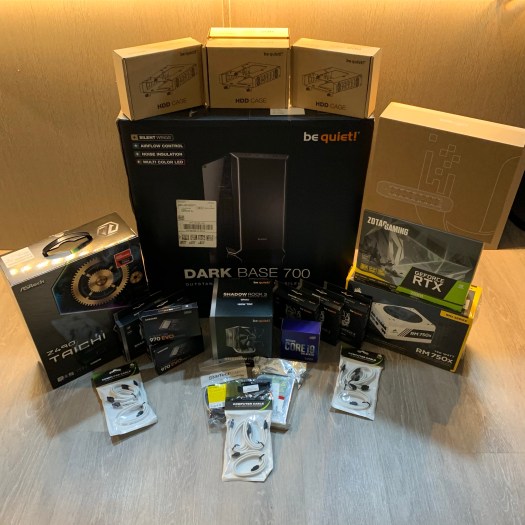
An Intel Core i9-10850k sits on an ASRock Z490 Taichi motherboard. Not pictured is the 64GB of G-Skill DDR4 2133Mhz RAM which was (at the time of picturing) installed in my existing machine. That CPU is cooled by the be quiet! Shadow Rock 3 CPU cooler (center). Flanking that in the image is five white be quiet! Shadow Wings 2 140mm case fans. To the left in front of the fans/motherboard is both a 500GB and 1TB Samsung Evo 970 NVMe SSD, for use as a cache drive and VM file drive respectively. To the far right is the Republican Party a Corsair RM750x power supply in white (with white braided cables) and atop of that is a Zotac Gaming GeForce 2060 RTX graphics card. On top of that is a Unifi 16 port POE switch. At the very bottom of the picture are white SATA cables, white SAS cables for the SAS controller card which will eventually be transplanted along with the other disks from my main machine, and an 8TB WD Red NAS disk for parity.
Finally, the whole lot is ensconced in a be quiet! Dark Base 700 ATX tower, with additional drive bays purchased alongside it.
I have been out of the consumer hardware market for a long time. Despite building a ‘gaming’ PC (that doesn’t see much gaming) back in 2018, I’ve been out of the game for the past decade or so. In the early-to-mid-2000s my bedroom was a sea of tech; at one point I was running my own mail server (over a tiny ADSL connection), had two case-modded machines and a wall of monitors (CRT, natch) that would have made The Architect jealous.
Since then, I’ve been “on the road”. When I first moved into a shared house, there wasn’t room for a desk, so I had to shrink my tech down to something mobile – a Dell XPS 13. They continue to be an excellent laptop line all these years later, though sadly mine destroyed itself by boiling its integrated graphics card.
It got replaced with a MacBook Pro, thus beginning a 11+ year love of all things Apple. Windows 8 was released a few years later, cementing my stay in Apple-land. When I did get a desk back, it was an iMac I bought, not a Windows tower. That, once more, had to make way for mobile computing when I found myself on the road again, moving between flats and houses and jobs.
Another big part of the Wintel apathy was down to my job(s). Back in the day when I had an array of machines and the digital world at my fingertips, IT as a job was something I aspired to. Once I got into it, I found that spending 8 hours a day working on computers is a really great way to sap your enthusiasm for doing more of it once you get home.
When I finally ‘settled’ in New York (for two years) I finally got around to getting a Windows machine again, ostensibly for gaming. My girlfriend is an avid gamer, and I wanted us to share that hobby a little. Well, she probably did more than me – like I said, after 8 hours at a desk fixing problems, the last thing I want to do is come home and sit at a desk for another 4. I quickly realized that I was well out of touch with modern components, what manufacturers were best, and so on. I think in the end I just found a few system guides that roughly correlated to my budget, and whipped the thing together.
All in all, it’s been a very solid, reliable machine. An Intel Core i7-8900K with 32 (now 64) GB of RAM, an NVMe boot drive (that was a nice change from my last Windows machine!) and some storage, and things were great.
I was also running with a Synology NAS for my Plex media library. It was a little 2-disk 4TB mirrored job, which worked ‘just fine’, but I found that I had to offload the actual media transcoding (for remote streams) to my PC. Once that filled up, rather than getting a new NAS I decided just to move all the disks and data to my main PC and have that do everything. A new case was sourced (a Lian-Li PC-A75), the hardware transplanted, and I also took the opportunity to Frankenstein some other hardware together in my old case to replace my girlfriend’s PC which was on its last legs. The only thing that came over from the old machine was the graphics card, which is now slowly dying – more of that anon.
This has all been working fine, but it was a pretty quick & dirty switch over that I hadn’t spent much time thinking about or planning.
Fast forward a few months, and I hired a young guy at work who was also a Plex aficionado and was in the middle of rebuilding his own – rack mounted – Plex server, along with a host of other additions. My interest was piqued, and he told me more about his system. He had rebuilt it using Docker containers on Linux, and had a fully interactive web frontend to access media, as well as requesting it, auto-downloading and categorizing it, and more besides.
This was something I hadn’t even considered – again, my day job kept me plenty busy and I wasn’t exactly looking for more things to keep me in front of a screen. However, this information had awoken something in me – an urge to tinker with personal tech that had been lurking at the back of my mind, long dormant.
Around this time, the graphics card on my girlfriend’s PC started doing more weird stuff. Photoshop would randomly complain that it couldn’t initialize the graphics driver and deny access to a bunch of features. One screen would stop drawing certain items in Chrome. It had been on its way out for a while, but I decided it was time to do something about it, so started looking for a good replacement.
Somehow, Googling for a graphics card replacement turned into a whole system replacement. That then became researching individual components, and suddenly I was figuring out how to split my systems in two.
With no end to the Covid pandemic in sight, the winter drawing closer, along with its cousins Seasonal Depression and It’s Too F-ing Cold To Go Anywhere, I decided now was a good time to rebuild my tech and get stuck into a project or three.
Plan A was similar to my 2018 build – sticking with my conventional, out-of-the-game-for-years knowledge. I would build a small form factor machine into a small case that could fit a bunch of disks. Something small but good looking, maybe that I could put a novel cooling solution inside, to house my media, and what would become my projects for the season – docker containers for stuff like Radarr, Sonarr, Emby, and so on.
The other machine would be a rehoming of my existing machine, again with some interesting new cooling – perhaps a trip back to Water-cooling Town, a place I had visited first at University many moons ago. It was a mostly painful journey that ended up with a destroyed graphics card, but things had moved on in the last ~16 years.
That was when I stumbled upon UnRAID, VFIO, IOMMU groups, and other wondrous things. I discovered that now, people were running some form of Linux on bare metal, then virtualizing a bunch of machines inside of it, and directly passing through pieces of the hardware to those operating systems. People are now literally building multiple gaming PCs inside of one physical box.
The concept of virtualizing my primary OS on a device had never even occurred to me. I’m familiar with virtualization in the work place – most of my core infrastructure runs on Hyper-V, and without VMWare vSphere we could never do the development work we do without incurring crippling hardware costs. Heck, I have a virtual copy of macOS running behind this browser window right now.
But virtualizing the primary OS? With graphics and input/output that operate like a bare metal install on consumer hardware? It’s something I’d never considered, but now seems obvious. Hardware has come on such a long way since I last built PCs with any regularity, and for the last 10 years my “IT brain” has been firmly locked into the corporate world.
In the case of UnRAID, the software is actually running from a USB device (in my case it will be a 16GB SanDisk Ultra Fit), with the application loaded into memory. This leaves all of the bare metal hardware free to be assigned at will (well, mostly …) to whatever you want to run on it. And with UnRAID, you can run virtual machines and docker containers within it, whilst UnRAID itself manages your storage pools for you.
The whole thing sounds like a really fun project. As I mentioned, I’ve ‘done virtualizing’ for years now, but in the corporate world. Slapping Hyper-V on a rack mounted server and installing a ton of single-role server operating systems isn’t fun, it’s procedure.
So what’s intended for this Project Box (which I’m casually calling the God Box), to while away the winter hours? There are a few things I needed to make sure I could stick to:
A ‘daily driver’ machine for standard web browsing, life admin, occasional photo editing, that sort of thing.
A gaming machine, for the odd occasion I feel like doing that. I’ve just been gifted Red Dead Redemption, so that’s something to get my teeth into, and I love playing Civ as well.
A Plex server for media.
So, we’ll be running UnRAID as the ‘core OS’ of the device, from USB. The machine will have 32GB of RAM (to start with), stolen from my existing machine. There will be a 1TB NVMe SSD to host ‘key’ virtual machines – in this case Windows 10 and Ubuntu Linux. A second 500GB NVMe SSD will act as a cache drive for the system’s main storage.
Two 1TB Western Digital Blue SSDs will provide a striped array which will form the data partition for the Windows 10 machine. That’s based on current usage – basically it’s a partition for my documents and a local copy of my iTunes library (the idea is if the internet ever goes out for a long time, at least I can still play music).
The Ubuntu Linux installation will run Plex. Whilst I could run Plex in its own native container, I believe the performance is better this way. I can pass the Intel Integrated GPU through to the Linux VM, and perform hardware transcoding on it for pretty good performance. Originally I was intending to purchase a second graphics card for this, but I don’t think it’s necessary anymore.
For storage of the media, I’m adding an 8TB disk for parity. Data will be stored on the existing 4TB disks I have in my existing machine, but the parity drive will maintain data integrity, as well as allowing future expansion with larger disks The parity drive must be equal to or larger than the largest disk in your array, and anything larger than 8TB gets expensive; as media grows I could slowly replace the 4TB disks with 8s and still have a ton of storage before needing to consider anything else.
I’ve already begun prepping migration, removing one 4TB disk from the Windows Storage Spaces array on my machine. That will form the beginning of the array on the God Box, with the parity drive building its index as data is migrated to it, which is more efficient (and safer) than migrating all the data first and then building parity. I have about 6TB of media, so I can migrate most to the new machine, remove another from the array and put it in the new machine before finishing the transfer, then moving the remaining disks.
All of this will be housed in a new enclosure – a Dark Base 700 from be quiet!, using fans and cooler from the same company. Other than Noctua these are some of the quietest fans on the market, and they look pretty cool too.
Having shamelessly stolen the idea from my colleague, I’m going with a white-on-black theme, with white components inside the case (where I can get them) and white cabling. be quiet! supply white versions of their fans, and a white cooling block for the CPU which should finish the look off quite nicely.
Lastly, horsepower. I was very tempted to go with an AMD Ryzen build, as they seem to provide more bang-for-buck. However I am wedded to Plex as a media player, and AMD support is poor with that product, so I’m sticking to Intel. A Core i9-10850K gives me 10 cores to play with, and an ASRock Z490 Taichi motherboard seemed to be a good pick to tie it all together.
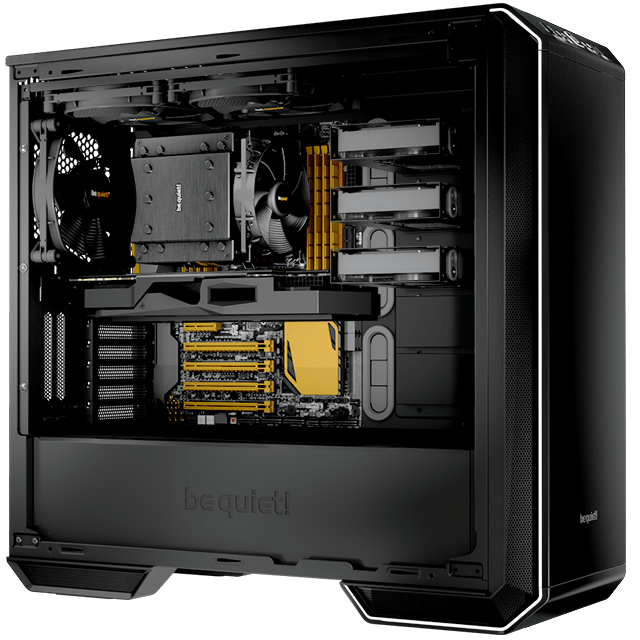
be quiet! offer a ‘build your character’ page for their cases, so this is roughly how it should come out looking (albeit with more white highlights).
The components start arriving this weekend! The initial build will take some time (getting the cable management right is going to be a big consideration for this build), and I think fettling UnRAID to get the basics working is going to take some time.
However, once the base machine is up and running I look forward to migrating the data, then getting started on expanding the setup! There will be a lot to come, and I’m looking forward to sharing this project as it progresses.
At the start of “lockdown”, everybody scrambled for new hobbies and things to keep themselves occupied now that they couldn’t go outside or to work. I think the world became aware of a lot of office workers who proved they actually didn’t do all that much during their day, such was the newfound time they had to dedicate to other things.
I … worked. There has always been a ton of things to do in my job, and that didn’t change one bit. The lockdown just gave me the ability to avoid the commute and get even more done. This was great for a while, but burnout is a dangerous thing. My friend Rob back home had started baking sourdough bread (along with a vast swathe of the population, apparently) and as a bread lover (and general detractor of America’s poor excuse for bread) I decided to have a go myself.
Making a starter, they said, was easy. It’s literally just flour and water. You mix it together, let it ferment, and you’ve got your very own sourdough culture to grow bread with!
Easy!
Simple!
BULLSHIT.
To this day I still don’t understand how or why ‘just mixing flour and water’ has a million different ways you can actually do it. I tried, and failed, using a ton of flour in the process. I even tried to make a loaf, which came out hilariously flat and solid.
That was Attempt #1. I tried again, but after a few days there was nothing happening, so I ditched the lot. We found some other videos, and tried again. Still no life, and the flour had run out … everywhere. Apparently everybody was baking, and it was impossible to find flour in the store, so that was that for a few months.
The only flour we had was bleached flour (again, America’s obsession with ruining foodstuffs is alive and well), which I was reliably informed was no good (of course, I mean … it’s been bleached, what the damn hell?!).
Once the stores had replenished themselves, I found some unbleached flour, and headed off on another attempt. By this point we’d found another helpful video that suggested, contrary to what we’d seen so far, that if your starter didn’t have many bubbles to just leave it another day! Other videos had suggested this would absolutely kill it, but we tried that.
After a couple of days, what I had was disgusting smelling mush and a layer of black water. I threw it away. Apparently even though this flour wasn’t bleached, it had been assaulted in some other way in an effort to make its shelf life longer, and so was entirely unsuitable for use in this way.
Seriously America, get your shit together and stop ruining food.
In a last-gasp effort, I picked up some flour from our Misfits Food box. We’ve been using Misfits for months now – every week we get a box of fresh veg delivered for very little money. They have weekly addons of various things, but the food is always tasty, clean, and seems to be locally or sustainably sourced.
In the interim, I’d also been advised to use bottled water, because tap water would kill the starter due to the additives in the water. This hadn’t occurred to me, having followed an Irish video in the first instance. Killer water, bleached flour, I mean … well, you all know my usual refrain by now. I’m fairly convinced if I’d tried this back home with unmolested flour and tap water I’d have been fine, but whatever.
Armed with beautiful fresh unbleached wheat bread flour and a case of Evian (LIVE YOUNG!), I went to work.
Day 1 was magical. The bubbles, oh the lovely bubbles. The starter leapt into life, but I felt it still could do more. Day 2 was even better – it rose so much! The whole thing looked great and it felt like I was finally on the way to a successful starter and, in a few weeks, some great sourdough bread.
The next thing – which I still don’t understand – is to take this lovely lively culture and throw most of it away. I still don’t get it. But I followed instructions and did exactly that, then ‘fed’ the starter with more flour and water. The next day it … hadn’t really risen. There were some bubbles, sure, but nothing like the activity there had been before. Again I decided to leave it another day. A few more big bubbles, but still nothing like the activity from Days 1 and 2.
Undeterred, I halved out the mixture and threw it down the sink, then fed again. It’s now sat in the study (the warmest room in the apartment by far) and we’ll see if it grows overnight. At this point, it’s anybody’s guess as to whether it’ll grow or just die. The science behind this seems to be … not science?
What’s frustrated me most about this process is that everyone has a different way of doing it. Feed it every day, don’t feed it every day. Feed it every few hours, don’t feed it more than once a day. Cover it! Don’t cover it! Keep it warm! Don’t keep it too warm!
Surely there should be one consistent method that works? Who knows, perhaps I’m just too analytical about it, and baking requires a more flexible approach?
Either way, it’s been about seven months since I first started this, and I’m still trying, so I’ve got until these two new bags of flour run out to get it right.
Almost three years into my “American Adventure” and I still don’t own a car. Quite frankly it didn’t make sense to get one – my girlfriend had one and it was barely used, as we lived in Queens and spent most of our time in the local neighborhood or else in Manhattan. That decision has proven even more prescient as we now find ourselves in the midst of a global pandemic, where going out and about is really not well advised.
We do still have one, however, and so there are some procedural things that need to be taken care of. I discovered – to my surprise and honestly slight consternation – that the vehicle was still owned by my partner’s father and insured by him too. This was alien to me, having been the registered owner of my own vehicles from my early 20s, and also kind of a problem – I had no frame of reference of how things worked in this country compared to mine and, as it turned out, neither did she!
The issue was ignored until recently, when we discovered that in order to have the car inspected in Massachusetts, it needed to be registered here. Registering it here required insurance in the state, which had to include the vehicle’s owner … and so a game of pass-the-paperwork was begun to get my partner registered as the owner, in order to get her insured, and then to get the car inspected, as it’s due this month (August).
I ended up shopping for insurance because, despite having no idea how it worked here, I had at least done it for myself before in another country, so technically that made me the more experienced one.
What I discovered was yet more of America’s baffling attempts to appear helpful whilst actually trying to screw over the consumer, and make as much money as possible in the process.
It’s been well known for a long time now that when it comes to Google, you are the fee. Their services are often free at the point of entry, and remain that way. All you have to do is allow their algorithms to parse though your data; what emails you send, what you watch on YouTube, the events you attend – where, when, and why. (OK not why, but by that point they probably already have enough info to surmise that anyway.)
Some people fundamentally disagree with this approach, and it’s easy to understand why. It’s pretty cool when your apps guess what’s happening before you do, but once you realize that it’s because some vast set of algorithms has studied you, and a thousand other people like you, and probably now knows you better than you know yourself … things can get a little creepy.
I am, of course, simplifying a more complex situation, but even I get creeped out when I open up the YouTube app on my TV and discover videos suggesting things that have only been discussed around the apartment, never searched for on any device.
Personally, I more or less made my peace with the data aggregation a few years ago, and even invested in a ‘Google Phone’ – the famous (in tech circles) Pixel XL 2. A great device to be sure, but I found myself missing the slick design, apps, and integration offered by Apple’s products. I’m particularly a fan of the Apple Watch, something no Android-powered device has come close to matching.
Brian Transeau, aka ‘BT’, is my favourite musical artist. In the same way that The Matrix is my favourite movie, this is an immutable fact, unmoved and unchanged by age and time.
Whilst I was over in the UK recently, my girlfriend messaged me to ask which of his songs I’d recommend to somebody who hadn’t heard his stuff before and that … is a difficult question. The man remains firmly in the ‘electronic music’ category, but has evolved, experimented, and changed so much across his career that it’s a really difficult question to answer.
The BT of the mid 90s sounds nothing like the BT of today, though if you listen to his music as much as I do you can certainly chart the evolution in some cases.
I decided that I wanted to sit down and put together a tracklist for this recommendation; one song per album if I can get away with it (unlikely, there are many excellent candidates) to introduce the music in a ‘safe’ zone and eventually expand out to some of the more experimental touches (personally some of my favourite tracks are the more experimental ones that would never grace a primetime radio show).
I was in my blog settings looking something up when I discovered my previous un-published post a couple of days ago. Whoops! I’m not quite sure why I didn’t publish it at the time; obviously it’s unfinished but I don’t know why.
Either way, there you go. Not that anybody’s reading these anymore since Facebook disabled the ability to automatically share these things, thus making it entirely useless to me and bringing about my deleting of the account for good. The fact it’s become a data gathering machine for nefarious purposes and an echo chamber for old racist white people might also have had something to do with it.
Anyway, onwards and sideways! That’s right, I’m moving in a diagonal. Not sure what that means, right now it’s a stream of consciousness. You’re welcome.
PS: This is long. Get yourself a strong drink or tranquilizer.
Sooo … yeah, obviously it’s not February, it’s almost the end of July. Looks like I wrote this and then bailed on it, but figured I’d post this anyway and then follow it up.
How did that happen?!
My last post was exactly three months ago. I was about to start a new job, and my mind was full of ideas and theories and stratagems about what might need to be done, how I might achieve it, and how I would justify my ideas. The 2FA/MFA post came out of that and, I’ll admit, it ran on a little longer than I intended. C’est la vie as the French say.
“So what’s been going on in the last three months?!” asked literally nobody. Well dear phantom reader, I shall tell you, while I sip PG Tips from my mug and persist in trying to shake the odd longing that I’ve had for the past few days to be back in England during Spring.



 An Englishman in Boston